


Driving License Upper Age Limit In India
Jan 16, 2010 Seniors over 75 yrs may be barred from driving. Officials said the new norms will transform the driver's licence from being a ‘proof of identity' to a ‘proof of skill'. The exercise is aimed at reducing road accidents in the country by making sure that only qualified people take to the wheel. Around 1.14 lakh people die on the roads in India. An individual becomes eligible to receive a permanent driving license after 30 days of issuance of the learner’s license. The minimum age for holding a permanent driving license in India is 18 years.
Driving in India is governed by various legal powers and in some cases is subject to the passing of a driving test. The Ministry of Road Transport and Highways, a branch of the Government of India, is the apex body for formulation and administration of the rules, regulations and laws relating to road transport, national highways and transport research, in order to increase the mobility and efficiency of the road transport system in India. Unlike most countries in the world, Indian traffic drives on the left.
Speed limits[edit]
The national upper speed limit is 140 kilometres per hour (87 mph) for cars, 80 kilometres per hour (50 mph) for motorcycles, and varies for other categories of vehicle. Until 2014, there was no national upper speed limit for cars in India, as local police set the limits in their own areas. Local governments are still encouraged to set specific limits within their own jurisdiction.[1]
As with the United Kingdom, traffic drives on the left side of the road in India. Driving under the influence—the limit in India is 0.03% blood alcohol content—is punished heavily, a first offence could result in a ₹10,000 fine and or a prison sentence of up to six months. A seatbelt must be worn when driving in cities, but is only advisory elsewhere.[2]
Pedestrian crossings[edit]
There are two broad categories of pedestrian crossing to aid the safe passage across major roads by those travelling on foot.
- Traffic light controlled crossings: Drivers are controlled by traffic light signals.
- Zebra crossings: Black and white stripes are painted on the road. Drivers must give way to pedestrians on the crossing.
Driving licence[edit]
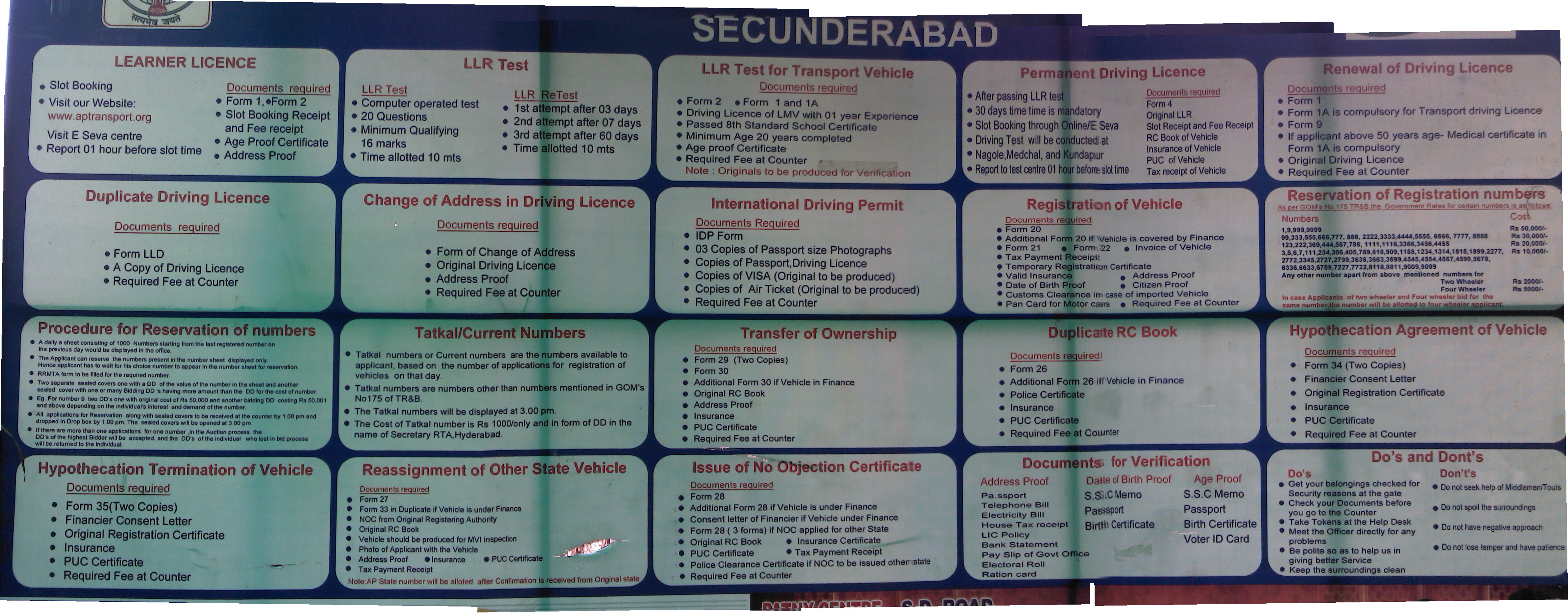
Driving licences may be obtained by any citizen of age 18 or above, subject to certain conditions. Initially, a provisional licence is issued, which restricts the holder to driving whilst accompanied by a driver who has held a full licence in the category of vehicle they are supervising the learner driver. The provisional licence may be exchanged for a full licence after the holder has passed the driving test. On reaching the age of 50, drivers may apply to have their licences renewed with a medical/fitness certificate. Many foreign driving licences permit one to drive in India for a period of one year.
Enforcement[edit]
Some of the rules of the road should be enforced by the police. Motorists convicted of certain traffic, and certain non-traffic offences may have 'points' added to their licences: some traffic violations, typically warrant three points, and motorists with twelve points face a temporary driving suspension.
Fatalities[edit]
India is generally considered to be one of the most dangerous countries in the world in which to drive.[3][4][5] In 2007, more than 130,000 people died on the roads in India, though the number should be weighted against the large population of the country. A representative of Delhi's Institute of Road Traffic Education suggested that among the main causes were the lack of traffic management, 'we do not design traffic management systems to separate different streams', and poor driver training.[5] A 2014 article published by Reuters described a driving test in Delhi, which lasted less than two minutes, and involved one examiner testing ten people at the same time.[4] Peter Foster, a journalist for The Daily Telegraph, recounted that in his experience, fellow drivers paid little heed to the rules of the road, and did anything they could do avoid queuing; succeeding in blocking up more of the road.[6] The wide variety of methods of transportation, and what is often portrayed as a common disregard for the rules of the road, contribute to the fatalities.[citation needed]
See also[edit]
References[edit]
- ^Dash, Dipak K (22 August 2014). 'Now, cars can zoom at 100kmph, bikes at 80'. The Times of India. Retrieved 10 February 2015.
- ^'Foreign Drivers in India: Legal Aspects'. InterNations. Retrieved 10 February 2015.Cite web requires
website=(help) - ^Nelson, Dean (7 March 2011). 'India to make dangerous drivers work as traffic police'. The Daily Telegraph. Retrieved 12 February 2015.
- ^ ab'FEATURE-India plans to step up safety on world's most dangerous roads'. Reuters. 3 November 2014. Retrieved 12 February 2015.Cite news requires
newspaper=(help) - ^ abRamesh, Randeep (10 October 2008). 'Indian roads officially the most dangerous in the world'. The Guardian. Retrieved 10 February 2015.
- ^Foster, Peter (10 August 2007). 'Driving in India: not for the faint hearted'. The Daily Telegraph. Retrieved 10 February 2015.
In This Article
- Driving Age by State
- Night Driving Restrictions
- Cellphone Restrictions
Getting a driver's license is a rite of passage for many teenagers. But sadly, car crashes are the number one cause of death for young people.
Many scientists argue that 16-year-olds just aren't mature enough to drive. Their brains aren't yet fully developed and they're more likely to take risks, become distracted, and make mistakes.
As a way to help teens slowly gain driving responsibilities one step at a time, states adopted graduated license programs. These programs have restrictions for newly licensed drivers, such as a limit on the number of passengers or a curfew.
A 2017 study found that graduated license programs have been instrumental in reducing car crashes among 16 and 17-year-olds. In fact, it's been so successful that some states are considering adopting graduated license programs for 18 to 20-year-olds who are becoming first-time drivers.
Each state in the United States establishes their own driving laws, including laws about the age at which teens can begin driving, and the rules vary greatly about graduated license requirements.
Driving Age by State
The age at which teens may obtain their learner's permit and the laws about graduated licenses vary by state. Be sure to check your local laws to find out when your teen can begin driving.
Learning with a Learner's Permit
Research shows many parents aren't good at teaching kids to become safe drivers. Instead, they depend too much on driver's education programs.
Driving Licence Upper Age Limit In India
Once your teen has a learner's permit, don't think of yourself as a passenger when your teen is behind the wheel. Think of yourself as a teacher.
Driver License Age Limit
Help your teen learn to recognize potential safety issues while driving. Give instructions to help your teen improve and provide plenty of constructive feedback.
Each state has different laws about learner's permits and how many hours a teen needs to be behind the wheel. Take those laws seriously and make sure you're helping your teen gain the experience they need to become a safe driver.
Night Driving Restrictions
While a lack of sleep impairs everyone's performance, studies show sleep deprivation takes the most serious toll on teens. Teens are more likely to make errors when driving later into the evening.
Upper Age Limit For Shingrix
Approximately two out of five teen car crashes occur between 9 p.m. and 6 a.m. , so many states have enacted curfews to prevent teens from driving during the overnight hours. For example, Alabama doesn't allow newly licensed teens to drive between midnight and 6 a.m., North Carolina doesn't allow teens to drive between 9 p.m. and 5 a.m.
Passenger Restrictions
Researchers have found that for each passenger a teen has in the car, the risk of a car crash increases. Friends can serve as a serious distraction and they may encourage your teen to take unnecessary risks. Consequently, many states have decided to restrict passengers in cars driven by teens.
While some states don't allow newly licensed teens to have passengers for several months, others restrict the number of minor passengers that can be in a car. Exceptions are usually made for siblings.
Cellphone Restrictions
Talking on the phone while driving serves as a major distraction that increases the likelihood a teen will make driving mistakes. So many states have adopted specific cellphone restrictions for young drivers.
Unfortunately, some studies show cellphone restrictions may actually increase the chances that a teen will attempt to send text messages while behind the wheel. In an attempt to conceal cellphone use, teens may become even more distracted by trying to type messages on the sly.
So it's important for parents to talk to teens about the risks of distracted driving. And if a teen is caught sending messages or using a cellphone while driving, there should be clear consequences.
A Word From Verywell
When it comes to letting your teen drive, don't depend on your state laws to keep your child safe. Create your own rules and restrictions for your teen's specific needs.
Keep in mind that just because your teen is old enough to drive legally, it doesn't mean they're mature enough to handle the responsibility.
If your 16-year-old is aggressive, impulsive, or irresponsible, don't let them behind the wheel just yet. In order to be safe drivers, teens need to be able to think clearly, make good decisions, and resist temptations.
Once your teen has a driver's license, increase their freedom slowly. Remember, you don't have to grant new privileges just because the graduated licensing laws allow him to drive at night or use a cellphone in the car. You can continue to impose restrictions of your own.
If your teen violates the law or breaks your rules, give them consequences. Take away their keys for a while or restrict the hours or places your teen drives.
And consider enrolling your teen in programs that teach driver safety beyond driver's education. You might get a discount on car insurance, but more importantly, additional driver training could save your teen's life.
Romer D, Lee YC, Mcdonald CC, Winston FK. Adolescence, attention allocation, and driving safety. J Adolesc Health. 2014;54(5 Suppl):S6-15. doi:10.1016/j.jadohealth.2013.10.202
Teen and novice drivers. Governors Highway Safety Association.
Goodwin AH, Foss RD, Margolis LH, Harrell S. Parent comments and instruction during the first four months of supervised driving: an opportunity missed?. Accid Anal Prev. 2014;69:15-22. doi:10.1016/j.aap.2014.02.015
Martiniuk AL, Senserrick T, Lo S, et al. Sleep-deprived young drivers and the risk for crash: the DRIVE prospective cohort study. JAMA Pediatr. 2013;167(7):647-55. doi:10.1001/jamapediatrics.2013.1429
Shults R, Williams A. Graduated Driver Licensing Night Driving Restrictions and Drivers Aged 16 or 17 Years Involved in Fatal Night Crashes — United States, 2009–2014. Morbidity and Mortality Weekly Report. Centers for Disease Control and Prevention. 2016; 65(29):725–730.
Chen LH, Baker SP, Braver ER, Li G. Carrying passengers as a risk factor for crashes fatal to 16- and 17-year-old drivers. JAMA. 2000;283(12):1578-82. doi:10.1001/jama.283.12.1578
Mccartt AT, Kidd DG, Teoh ER. Driver cellphone and texting bans in the United States: evidence of effectiveness. Ann Adv Automot Med. 2014;58:99-114.
Additional Reading
- Centers for Disease Control and Prevention: Teen Drivers: Get the Facts.
- Insurance Institute for Highway Safety: Consumer Safety Brochures.
- Williams AF. Graduated driver licensing (GDL) in the United States in 2016: A literature review and commentary. Journal of Safety Research. August 2017.